



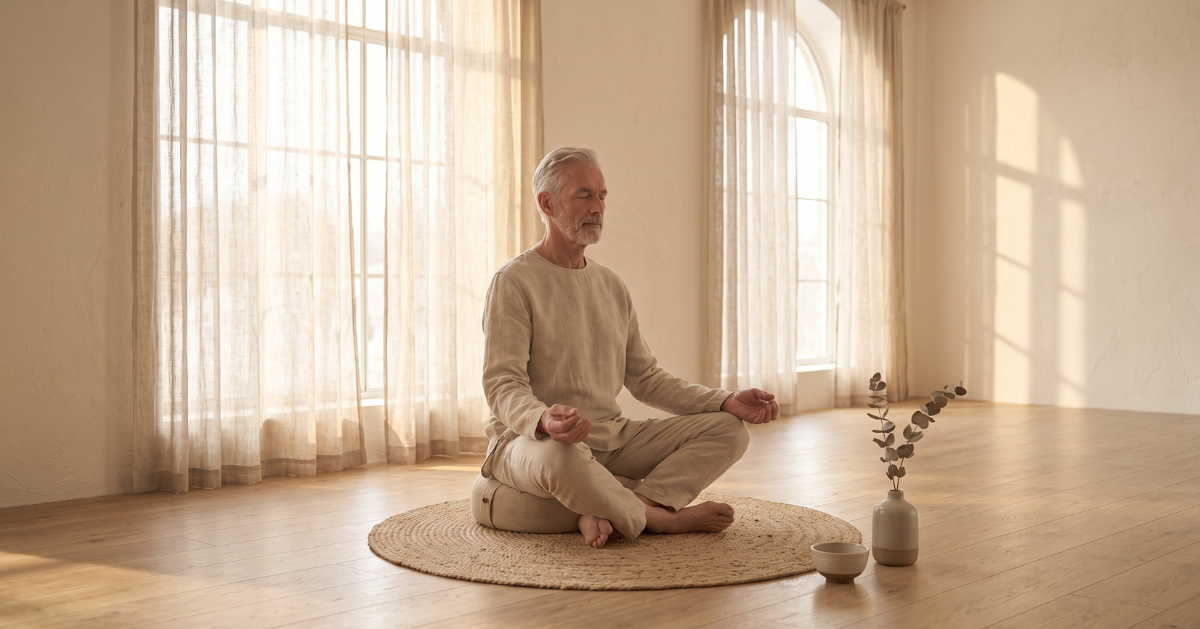
Your knees don't fold like they used to. Your hips feel like they've locked up somewhere between sleeping and standing. And every meditation app tells you to "just sit comfortably," which sounds like a joke when you can't remember the last time you sat on the floor without help getting back up.
You're not doing meditation wrong. You just need a setup built for the body you actually have, not the one you had at 30.
The short answer
If you're over 60 and want to meditate at home, get a meditation cushion filled with adjustable buckwheat hulls and pair it with a zabuton mat for your knees. If sitting on the floor is off the table, use a firm meditation bench or a straight-backed chair with a small cushion at your lower back. The rule that matters most is simple. Your hips should sit higher than your knees. Everything else is comfort.
Why meditation gets harder after 50
Your body changes in ways that make traditional cross-legged sitting harder. Hip flexors tighten. The inner rotation of the hip joint decreases. Cartilage in the knees wears down. And the sacrum, which is meant to tilt forward when you sit, often can't get there anymore because your pelvis has less mobility than it did.
None of this is a personal failure. It's biology.
But here's the part most meditation guides skip. When you can't get your hips above your knees, your lower back rounds. When your lower back rounds, your diaphragm compresses. When your diaphragm compresses, your breathing gets shallow. And when your breathing gets shallow, meditation stops feeling calm and starts feeling like a chore.
Fix the seat and you fix everything else.
The one rule that matters most
Your hips need to sit higher than your knees. That's it. That's the whole rule.
When your hips are higher, your pelvis tips forward slightly. Your spine stacks naturally. Your diaphragm has room to move. Your knees drop toward the floor instead of pointing at the ceiling. And you can sit for 20 minutes without wanting to stand up after five.
Here's a quick test. Sit on a firm cushion or a folded blanket. Look down at your knees. If your knees are below the level of your hip bones, you're good. If your knees are level with or above your hip bones, you need more height.
Most standard zafus sit around 13 to 15 cm tall, which suits many older meditators well when paired with a zabuton mat. If your hips are very tight or your legs are long, you may need extra height, either from a taller cushion or by stacking a zabuton and zafu together.
What to look for in a cushion for older bodies
Not every cushion works for aging joints. Here's what actually matters.
Adjustable height. Your flexibility changes from day to day, especially after 60. Some mornings your hips are fine. Other mornings you need an extra 5 cm. Cushions filled with loose buckwheat hulls let you add or remove filling until the height matches your body that day. Foam cushions don't adjust. What you buy is what you sit on, forever.
A firm but forgiving base. Too soft and you sink, which drops your hips and defeats the whole point. Too hard and your sitting bones ache after 10 minutes. Buckwheat hulls hit the middle. They compress slightly under weight but don't collapse.
A wide enough base. Some cushions are narrow, which works if you're small or flexible. If you have larger hips, or if you need to shift positions during a session, a wider base gives you room to move without falling off.
Natural, breathable fabric. Cotton or hemp covers breathe. Synthetic covers trap heat and sweat, which becomes uncomfortable during longer sessions. This matters more with age because circulation and temperature regulation both change.
Portability. If you can't easily move your cushion from the closet to the living room, you'll stop using it. Buckwheat cushions are heavier than foam, so look for ones with handles or a lightweight enough profile that you can carry them in one hand.
The setup we recommend for older bodies
Keep it simple. For most people over 60, two configurations cover everything.
The floor setup. A round buckwheat-filled zafu placed on top of a zabuton mat. The zafu lifts your hips above your knees. The zabuton protects your ankles and shins from hard floors, which matters most for anyone with arthritis. The SUMA Classic works well here because the buckwheat hull fill lets you top up or reduce the height as your body needs it, and the 4 degree forward tilt built into the shape puts your pelvis in a neutral position without you having to think about it.

The chair setup. A firm dining chair or wooden chair, feet flat on the floor, small rolled cushion behind your lower back. Sit forward on the seat so you're not leaning on the backrest. This is not a downgrade from floor sitting. It's a legitimate practice position that the CDC estimates around 51.6 million American adults live with chronic pain, and for many of them, chair meditation is the only way to build a sustainable practice.

Lying down. Meditation on your back is a real, legitimate practice. It's called body scan meditation and it's what many senior programs teach first. The one caveat is that lying down often leads to sleep, which is fine if that's what you need but not the goal if you're trying to build attention.

What the research actually says
A randomized controlled trial published in Pain studied 37 adults aged 65 and older with chronic low back pain. After an 8-week mindfulness meditation program, participants showed significant improvements in pain acceptance and physical function, and nearly half reported reduced use of pain and sleep medications at the 3-month follow-up.
The National Center for Complementary and Integrative Health lists meditation among the evidence-supported approaches for managing chronic pain, anxiety, and sleep problems in older adults, citing a 2017 analysis of 30 studies that found mindfulness meditation more effective at decreasing chronic pain than several other treatments.
The takeaway is that meditation works for older bodies. What often stops people isn't the practice, it's the physical setup. Fix the seat, and the practice becomes something you actually want to return to.
Setting up your space
You don't need a room. You need a corner.
Pick a spot near a window if you can, since natural light helps with morning practice. Keep a small shelf or basket nearby for anything you want within reach, like a timer, a shawl for cooler mornings, or a glass of water.
If you're using a chair, position it away from a TV or laptop. Face a blank wall or a window. Nothing else needs to be there.
The point is that the space becomes familiar. Your body starts to relax the moment you sit down because it knows what comes next.
Conclusion
Meditation doesn't need a perfect body. It needs a body that shows up.
If the floor works for you, use the floor. If the chair works better, use the chair. If lying down is the only position that doesn't hurt, lie down. The research on meditation for seniors doesn't rank one position above another. The people who benefit are the ones who keep sitting, in whatever shape their body allows.
Start with five minutes tomorrow morning. Same time, same corner, same cushion or chair. Do that for two weeks. Then decide if you want more.
That's the whole practice. Everything else is furniture.
Frequently asked questions
Are meditation cushions safe for seniors with arthritis?
Yes, when the cushion is the right height and firmness. The issue with arthritis isn't sitting itself, it's sitting in positions that compress affected joints. A cushion that raises your hips above your knees takes pressure off the knees and hips. A zabuton mat protects the ankles. If you have knee or hip arthritis, a bench or chair setup may be more comfortable than a floor cushion.
What height cushion should I get if I'm over 65?
A standard zafu around 13 to 15 cm tall works for most older meditators, ideally paired with a zabuton mat under your knees. If your hips are very tight or your legs are long, go taller (around 18 to 20 cm) or stack a zafu on top of a zabuton for extra lift. Buckwheat-filled cushions let you adjust the height by adding or removing filling until it fits your body.
Can I meditate on a couch or armchair?
You can, but soft couches make it harder to maintain an upright spine because you sink into them. A firm dining chair or desk chair with a small lumbar support works better. The goal is a stable base with your feet flat on the floor and your back upright but not rigid.
How long should I sit if I'm just starting?
Start with five minutes. That's it. Sit for five minutes a day for two weeks before adding more time. Most people fail at meditation not because they can't focus but because they try to do 30 minutes before their body or attention is ready. Five minutes done every day beats 30 minutes done once a week.
Are buckwheat cushions better than foam for older adults?
For most older meditators, yes. Buckwheat cushions are firm, adjustable, and breathable. Foam cushions are softer, which sounds like a good thing but actually causes your hips to sink, which lowers your seat below your knees. Foam also doesn't let you fine-tune the height. Buckwheat holds its shape for years and can be topped up if the hulls settle.
Is it too late to start meditating at 70?
No. Studies on meditation for older adults consistently show benefits regardless of when someone starts. The Journal of Population Ageing research covered practitioners who began in their 60s, 70s, and 80s. Cognitive and emotional benefits were consistent across age groups.


Leave a comment
All comments are moderated before being published.
This site is protected by hCaptcha and the hCaptcha Privacy Policy and Terms of Service apply.