



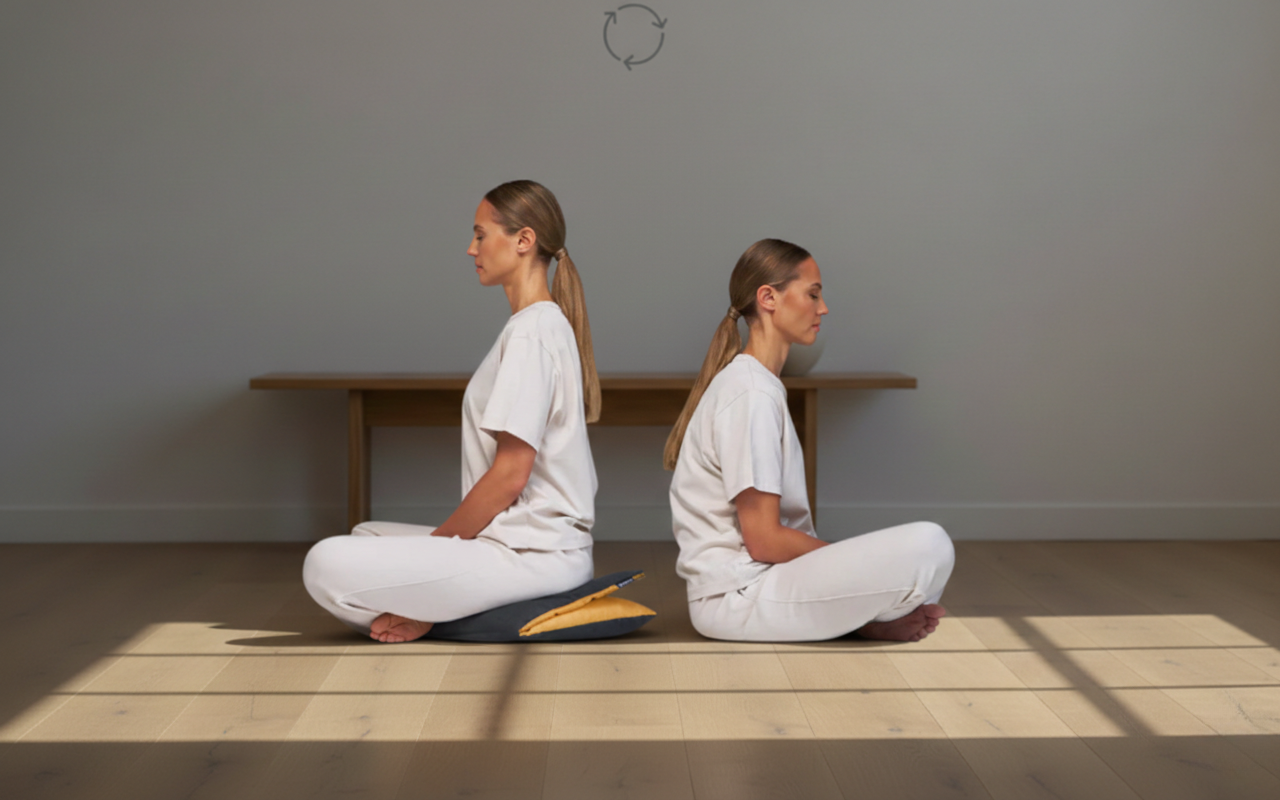
Many people think of meditation as a quiet time for the mind, but your body is usually the first thing to speak up. You sit down ready to relax, but suddenly you feel your lower back get tight, your hips pinch, and your shoulders start to slump.
Instead of feeling peaceful, you end up thinking about how much your back hurts. This does not mean you are doing it wrong. It just means your body and the floor are having a disagreement.
Ergonomic meditation cushions for back support are made to fix this. They aren't just fancy pillows or something extra you don't really need. They are tools built to help your body stay in its natural shape. When you use a proper meditation cushion, your body stops fighting to stay upright. This makes your practice feel quieter, deeper, and much easier to do every day.
What is an ergonomic meditation cushion?
The word "ergonomic" means designed for the human body. An ergonomic meditation cushion is built to work with your bones and muscles instead of against them.
Most pillows are flat, which forces your back to work hard to stay upright. This cushion is an instrument designed to support your pelvis and spine. Its most important feature is a subtle forward slant. This slant acts as a gentle nudge for your hips, letting them rotate so your spine stacks up naturally like a tower of blocks.
The cushion performs the work of holding you up so your muscles don't have to. To keep this shape, these cushions use firm materials like buckwheat hulls. Unlike a regular pillow that squishes, a proper back support meditation cushion stays firm. This keeps your weight spread out so you don't feel pressure in your lower back or hips.
How posture quietly shapes your meditation experience
Having good posture is about more than just looking like you have your life together. It is actually about how your body breathes and stays balanced. When you try to sit on a flat floor or a squishy pillow, your bottom naturally tilts backward. This makes your lower back flatten out, which forces your muscles to work non-stop just to keep you from falling over. After a while, your back gets tired, and the pain makes it impossible to focus on your meditation.
An ergonomic meditation cushion changes the game by gently lifting your hips and tilting them forward. This helps your spine return to its natural "S" shape so your body does not have to fight against gravity the whole time. When you aren't struggling to stay upright, your chest opens up and you can take much deeper breaths. Your brain gets a signal that your body is safe and stable, which is why ergonomic meditation feels so much easier on the mind.
Researchers have spent years studying how the way we sit changes how our bodies work, and they found that sitting on a flat surface is one of the hardest things for your spine and your lungs to handle. One important study by scientists at King Saud University looked at how slumping changes your breathing by testing healthy people in both upright and slouched positions. They found that when people slouched, their breathing muscles became much weaker, making it harder to take in a full breath.

Get this cushion here
The most common types of ergonomic meditation cushions
Because every body is built differently, there is no single meditation cushion that works for everyone. The right option depends on how you prefer to sit and where your body tends to feel strain. Most cushions fall into a few broad categories based on how they support posture.
1. The Round Zafu
This is the traditional round cushion commonly used for cross-legged sitting. Its main function is to raise the hips above the knees, which helps tilt the pelvis forward and reduce rounding in the lower back.
2. The Backrest Seat
This style includes a built-in support for the upper back. It can be useful for beginners or people whose thoracic spine tires quickly, as it provides feedback and support without forcing a rigid posture.
3. The Orthopedic Cushion
These cushions are contoured to match the natural shape of the hips and pelvis. They are often recommended for people with chronic discomfort or previous injuries because they reduce pressure concentration and help maintain spinal alignment.
Some modern cushions aim to bridge these approaches by combining height with orthopedic shaping, and SUMA’s cushions are a clear example of this design direction. Rather than relying on softness or bulk, they use a subtle forward slant to encourage a neutral pelvic position from the moment you sit. The idea is not to hold the spine upright artificially, but to make an upright posture the easiest option.
This approach is supported by ergonomic research. A study from Northwestern Polytechnical University examined how different cushion shapes affect comfort and pressure distribution using pressure-mapping technology. The researchers found that contoured and gently sloped seating surfaces distributed body weight more evenly than flat cushions, significantly reducing high-pressure zones around the pelvis.
These findings help explain why shaped cushions tend to feel more comfortable over longer meditation sessions. When pressure is spread evenly and the pelvis is supported in a natural position, the muscles of the lower back no longer have to compensate. As a result, the nervous system receives fewer pain signals, making it easier to remain still and relaxed without constant physical distraction.
The real benefits you feel when your body is properly supported
The most immediate benefit of an ergonomic meditation cushion for back support is comfort, but the deeper benefits go beyond that. When posture stabilizes, the body stops sending distress signals to the brain. This reduces mental restlessness and allows attention to settle more easily.
Pressure on the hips, knees, and lower spine decreases significantly. Circulation improves, reducing numbness or tingling in the legs. Over time, consistent use of a back support meditation cushion strengthens postural awareness, which carries over into daily activities like working at a desk or sitting on the floor at home. Many people report fewer aches outside of meditation once their body learns what aligned sitting feels like.

Get this cushion here
Conclusion
In the end, meditation should be about your mind, not your muscle aches. Using an ergonomic cushion is a simple way to help your body feel safe and quiet so you can actually enjoy your practice. By fixing the slant of your hips and taking the pressure off your spine, you stop the struggle and start the relaxation. Whether you are just starting out or have been practicing for years, a little bit of science under your seat can make a big difference in how you feel every single day.


Leave a comment
All comments are moderated before being published.
This site is protected by hCaptcha and the hCaptcha Privacy Policy and Terms of Service apply.